Thursday, December 11, 2008

Triffids remake!


Why the love affair with man-eating plants?

Triffids from the BBC's 1981 adaption

By Finlo Rohrer
BBC News Magazine

A new BBC adaptation is being made of The Day of the Triffids, but why are we still prepared to believe in a post-apocalyptic world roamed by flesh-eating semi-sentient plants? And do we have a love affair with fictionalised destruction?

Picture the scene. Something bad has happened. Very bad. The streets are deserted. The people are either dead or fled.

The cause could be a natural disaster - a volcano, a tsunami or an earthquake. It could even be something truly far-fetched - an alien invasion, giant lizards or a wave of famished zombies.

KEY APOCALYPTIC NOVELS
Mary Shelley: The Last Man (1826)
MP Shiel: The Purple Cloud (1901)
HG Wells: The Shape of Things to Come (1933)
George R Stewart: Earth Abides (1949)
Richard Matheson: I Am Legend (1954)

But the explanation seems often to be man-made, misguided aggression or science gone wrong - accidentally released plague, nuclear war, or genetic modification gone awry.

This is one of Hollywood's favourite genres - the disaster movie. Look over the biggest grossing movies of recent years, and disaster movies are over-represented. Between them, Independence Day, I Am Legend and War of the Worlds took well over $2bn at the box office.

Within this category of disaster movies there is a a powerful sub-genre, the "post-apocalyptic fiction". Stories of a world having suffered, or in the last throes of, total collapse seem to have a perverse hold on the cinemagoer.

Deserted London

The modern incarnation of this genre has its roots in the febrile atmosphere of the 1950s, and perhaps its greatest pioneer was John Wyndham.

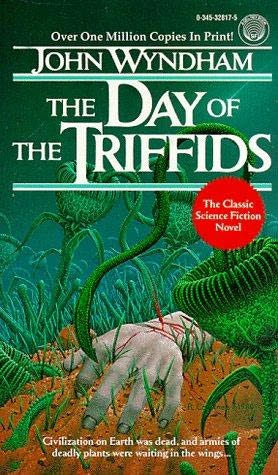
His 1951 novel The Day of the Triffids tells the story of a man, Bill Masen, who awakes in a hospital after treatment for temporary blindness caused by a sting from a genetically modified plant, a triffid.

The first 45 minutes of 28 Days Later are the first three chapters of The Day of the Triffids, marginally modified with the addition of zombies
Dr Barry Langford

Sensing he has been left unattended, he takes off his bandages to find the hospital is deserted. Upon leaving, Masen soon realises everybody has gone blind after witnessing spectacular lights in the sky the night before.

He, of course, was unable to watch the shower and has therefore retained his sight. The result of the epidemic of sightlessness is chaos and starvation, underpinned by a growing threat from the mysterious stinging triffids.

The tiny minority who have avoided blindness face difficult choices about how to continue their lives in a ravaged country, and how to deal with helpless blind survivors.

Its influence on some modern disaster films is apparent to any reader, says Dr Barry Langford, senior lecturer in film and television at Royal Holloway, University of London, and the author of the introduction to the Penguin Modern Classics version of Wyndham's novel.

"The first 45 minutes of 28 Days Later are the first three chapters of The Day of the Triffids, marginally modified with the addition of zombies."

Zombie lineage

Seeing a modern cinematic zombie lumbering unthinkably towards the hero or heroine as they try and make good their escape, it's not a massive leap to the triffids lumbering unthinkingly towards Bill Masen and Josella Playton, the resourceful heroine.
Armoured car in scene from 1981 adaption of The Day of The Triffids
Competing political views arise in the aftermath

Horrorphiles may trace the zombie lineage back to Richard Matheson's 1954 novel I Am Legend, but the triffids made their literary debut three years earlier.

Wyndham's work played with the paranoia of the Cold War then seeping into ordinary people's subconscious. In his novel, both the rise of the triffids (farmed for their oil) and the putative explanation for the blindness (an accidental release of chemical or biological weapons orbiting in satellites) are byproducts of the Cold War.

And the idea of malevolent plant life has a certain appeal now, in a time where some people are increasingly concerned about the idea of genetically modified organisms.

"The triffids are perhaps to us a more potent threat than even in Wyndham's time," Dr Langford suggests.

Rising seas

Andy Sawyer, librarian at the Science Fiction Foundation Collection at the University of Liverpool, concurs. "It has become relevant. There is a lot more anxiety about bio engineering now."

POLITICAL VISIONS IN THE NOVEL
Militaristic semi-feudalism
Polygamous pragmatism
Socialist idealism
Traditional morality

Apart from the triffids, Wyndham's other novels also cover topical issues. The Chrysalids tackles the idea of genetic mutation, possibly caused by nuclear war, and The Kraken Wakes tells of a world drowned by rising sea levels.

As well as meddling in nature, the relationship between cities and civilisation is a central theme in Wyndham's work.

At the heart of The Day of the Triffids is the idea that without cities there can be no civilisation. After everybody goes blind, the survivors cannot hope to sustain life in the cities. Pavements are soon cracked by weeds and streets overgrown.

"The empty city is a really powerful visual motif for the end of the world as we know it," says Dr Langford.

And in Wyndham's novel, the division of labour - and pampered lives - in modern society leaves people singularly ill-equipped where there is suddenly a battle for survival itself. One character rages that a group of women are unable to restart a generator.

Strange fantasy

"There is always a very strong sense of do we actually have the reserves to sustain ourselves? Have we become insufficiently robust?" says Dr Langford.

Wyndham's work provides a bridge from the work of HG Wells, Jules Verne and others, to the disaster and apocalypse fiction of today. It is as popular as it is today because it taps into a strange fantasy - a world in which we have avoided an all-embracing death and can do what we want.

APOCALYPSE THEMES
Science gone wrong
Ordinary man as hero
End of urban living
Need for old-fashioned skills
Competing political visions

"It's living on past the death of everything, living into a future that isn't mapped out and doesn't resemble anything we know," he says.

"When we die, everything ends, but in these stories that's inverted - everything ends but we get to live on. It is the world evacuated of everyone else. You can go into shops and have everything you want, live in any house you want."

And Wyndham's writing expounds an idea that is the template for many a modern film - the ordinary man, and ordinary woman, who have to take on a heroic mantle.

"He does follow that Wellsian tactic of making extraordinary things happen in ordinary circumstances. He saw himself as very much in the tradition of HG Wells rather than the American space opera," says Sawyer.

Wyndham also follows Wells in embedding an overtly political aspect in his science fiction. In the world that Bill Masen confronts, there are a number of different models for how to build society in the aftermath of the disaster.

Wyndham certainly did not invent disaster or post-apocalyptic fiction, and many of his ideas had precursors in earlier authors. But the way he expanded and expounded his ideas, and his popularisation of the nascent genre to a mainstream audience, make him an immense figure in science fiction.

Wednesday, December 10, 2008

Damnit I have to post something to move that video down a bit. so here is this:


and this:


looks like I need one more to fix this:

Daily links and an apology.


Sorry about the lack of posts this week people. I have been hunting down proper reference for more of the settings for the comic then BAM I will be working through the initial pages and getting a feel for the look I want for this story.


Here is a few links to tide you over til I can post in a few days again:

http://www.blueskycomics.com/benjamin/archives/2007_06_01_benblog_archive.html
http://www.darkfantasy.org/fantasy/
http://www.converse.com/index.aspx?bhcp=1&mode=collection1
http://www.501stlegion.org/index.php
http://www.i-am-bored.com/bored_link.cfm?link_id=33792
http://www.knuckletattoos.com/page/2/
http://www.comedy.com/embed/star-trek-plight-of-the-red-shirts

Friday, December 5, 2008

Forrest J Ackerman r.i.p.

Forrest J Ackerman, who discovered Ray Bradbury, credited with coining term sci-fi, dead at 92
12-05-2008 3:38 PM
By JOHN ROGERS, Associated Press Writer

LOS ANGELES (Associated Press) -- Forrest J Ackerman, the sometime actor, literary agent, magazine editor and full-time bon vivant who discovered author Ray Bradbury and was widely credited with coining the term "sci-fi," has died. He was 92.

Ackerman died Thursday of heart failure at his Los Angeles home, said Kevin Burns, head of Prometheus Entertainment and a trustee of Ackerman's estate.

Although only marginally known to readers of mainstream literature, Ackerman was legendary in science-fiction circles as the founding editor of the pulp magazine Famous Monsters of Filmland. He was also the owner of a huge private collection of science-fiction movie and literary memorabilia that for years filled every nook and cranny of a hillside mansion overlooking Los Angeles.

"He became the Pied Piper, the spiritual leader, of everything science fiction, fantasy and horror," Burns said Friday.

Every Saturday morning that he was home, Ackerman would open up the house to anyone who wanted to view his treasures. He sold some pieces and gave others away when he moved to a smaller house in 2002, but he continued to let people visit him every Saturday for as long as his health permitted.

"My wife used to say, 'How can you let strangers into our home?' But what's the point of having a collection like this if you can't let people enjoy it?" an exuberant Ackerman told The Associated Press as he conducted a spirited tour of the mansion on his 85th birthday.

His collection once included more than 50,000 books, thousands of science-fiction magazines and such items as Bela Lugosi's cape from the 1931 film "Dracula.
"

His greatest achievement, however, was likely discovering Bradbury, author of the literary classics "Fahrenheit 451" and "The Martian Chronicles." Ackerman had placed a flyer in a Los Angeles bookstore for a science-fiction club he was founding and a teenage Bradbury showed up.

Later, Ackerman gave Bradbury the money to start his own science-fiction magazine, Futuria Fantasia, and paid the author's way to New York for an authors meeting that Bradbury said helped launch his career.

"I hadn't published yet, and I met a lot of these people who encouraged me and helped me get my career started, and that was all because of Forry Ackerman," the author told the AP in 2005.

Later, as a literary agent, Ackerman represented Bradbury, Isaac Asimov and numerous other science-fiction writers.

He said the term "sci-fi" came to him in 1954 when he was listening to a car radio and heard an announcer mention the word "hi-fi.
"
"My dear wife said, 'Forget it, Forry, it will never catch on,'" he recalled.

Soon he was using it in Famous Monsters of Filmland, the magazine he helped found in 1958 and edited for 25 years.

Ackerman himself appeared in numerous films over the years, usually in bit parts. His credits include "Queen of Blood," "Dracula vs. Frankenstein," "Amazon Women on the Moon," "Vampirella," "Transylvania Twist," "The Howling" and the Michael Jackson "Thriller" video. More recently, he appeared in 2007's "The Dead Undead" and 2006's "The Boneyard Collection.
"
Ackerman returned briefly to Famous Monsters of Filmland in the 1990s, but he quickly fell out with the publisher over creative differences. He sued and was awarded a judgment of more than $375,000.

Forrest James Ackerman was born in Los Angeles on Nov. 24, 1916. He fell in love with science-fiction, he once said, when he was 9 years old and saw a magazine called Amazing Stories. He would hold onto that publication for the rest of his life.

Ackerman, who had no children, was preceded in death by his wife, Wendayne.

Thursday, December 4, 2008

On the subject of violence...

I have decided the graphic novel (title pending chapter 1's completion) will have violence where necessary to the story, for example -the opening scene is a gun battle on the streets of a "NYC inspired" city between rival gangs in car. Bullets flying, car crashes, people screaming and taking cover. I have decided however, there is a point that I feel is over the top. I decided this last night while watching the 2008 offering "Rambo".
Now before anyone hints at censorship, or suggestion of it. Before anyone decries I am old and am outgrowing violence- please remember who you are talking about. I love violence if it is a necissary part of a story. Not every story toldd can be hugs and handshakes. There are many times in life that violence is a direct result of decisions made, or for that matter desicions left un-made.
Now for those of you have not seen this movie I will tell you I spent much of my time watching this wondering if it is steroids or plastic surgery that has made Sylvester look the way he does in the movie. A 62 year old Sly Stallone dusted off his red headband and m-16 to take part in this blood bath. He is huge even compared to his former self. (See picture below.) He looks like a giant version of himself.
Now don't get me wrong I am a fan of explosions, bullets flying, people flying, people diving over stuff whilst shooting guns and screaming, blood and explosions (yes, I am aware I wrote explosions twice.) But this movie takes it to the extreme in two ways. Ok, let's start with the high body count- at 93 minutes it is the shortest of all 4 movies and far surpasses the rest. When released Rambo 3 was called the most violent film of all time*, but the new movie destroys the record. I mean the violence is pretty much contained in the second 2/3rds of the movie so it really is like 236 kills packed into an hour. The first three movies have a grand total of approximately 169 dead. That is a pretty high death toll, seeing that in the nightmare on elm street movies doesnt even come close to those numbers. niether does Jason Vorhees in the Friday the 13th movies. (as a side note both of those series are far beyond 4 movies and still they arent close to these numbers)
Secondly, the gore isn't silly because of suffering it becomes silly becuase of the sheer amount of it. There are so many explosions causing body parts to be thrown freely in this movie, you begin to see dismembered limbs bouncing off of other dismembered bits, like some sort of ghoulish high-five. There isn't enough screen to contain it all. There had to be an army of assistants that where in charge of throwing limbs, bits as well as buckets of blood.
Again, I say I am going to have violence when the story needs it, but it shouldn't be so prevalent that it is the focus because it all become self parody. Having a touching moment while killing someone at the same time, yeah, those arent the stories I am telling I guess.
Let us not even start with how this is acceptable in the US but full frontal nudity, never mind nudity at all is seen as the beginning of the end of the world.

Ah, foriegn film, my old friend how I missed you. C'mon Delicatessen, lets kick back and watch a little Amelie and talk politics with City of lost children. Maybe, Toto the hero will make popcorn for all of us while we take in Das boot. Damn, ok who invited Hardboiled? Ok I guess you can stay my blood soaked, bullet riddled friend.


John Rambo circa 1982 john rambo circa 2008

*The 1990 Guinness World Records deemed Rambo III the most violent film ever made, with 221 acts of violence, at least 70 explosions, and over 108 characters killed on-screen. However, the body count of the fourth film in the series, Rambo, surpassed that record, with 236 kills and an average of 3.2 kills per minute...Rambo holds the record with the most kills out of the entire Rambo series, with
263 kills ;[2] also the number is more than that of the previous three movies combined. Stallone justified this in a press conference by saying "the violence in the film was to underline the ongoing problems in Burma"-wikipedia

Wednesday, December 3, 2008

More "daily" links

More links for you, are to follow- but before that I am asking people that come here (which I fear may only be ME) for volunteers when the time arrives to proofread my graphic novel as it comes. By doing this I not only get some feedback but I also am setting deadlines for myself and that will insure a reasonable amount of work output. (In other words if I work with no deadlines i may never get this done. If I have concrete deadlines I will work to keep close if not to schedule.)

here are you links for today:
http://garfieldminusgarfield.net/
http://tv-links.cc/cartoon/venture-bros-the.htm
http://lolthulhu.com/
http://www.opacity.us/

Tuesday, December 2, 2008

Concept

I have been reading, and rereading blogs and essays about self publishing written by artists I admire. Jeff Smith creator of Bone(BONE RULES!) invited Colleen Doran a talented artist in her own right to write about her experiences with self publishing in the medium on his popular Boneville blog page. Dave Sim creator if Cerebus,(and though Dave has proved himself sexist on numerous occasions) with 300 issues spanning decades of work; it is hard to ignore as an accomplishment of the highest when it comes to the realm of self publishing, and his subsequent essays on the subject have been helpful as well.*

After reading numerous essays and books on comics, the graphic novel and about the art-form itself I have come to this realization: Story is of paramount importance, overshadowing nearly everything, except concept. You can have a great story but if the characters are unappealing, cliche, corny, trite or just plain dull- no one is going to care about your story. It is for this reason entire sections of my original concepts, notes even plot points have been revised. I am looking for a balance between classic and innovative. A fine line it can be trying to make a "classic" styled character (because of story purposes)without marching headlong into cliche territory.

I am hoping that with the designs I have been working on I hope will be interesting and not overly stale.

artwork by the amazing Jeff Smith!


*If anyone knows of any other great essays on the subject I am always looking for more motivation